※本記事はアフィリエイト広告(プロモーション)を含みます。
When you hunt for Number (N)ine on Mercari or in vintage shops, you often wonder: “Is this from when Takahiro Miyashita was designing?” “What year is it from?” The quickest clue is the label at the neck.
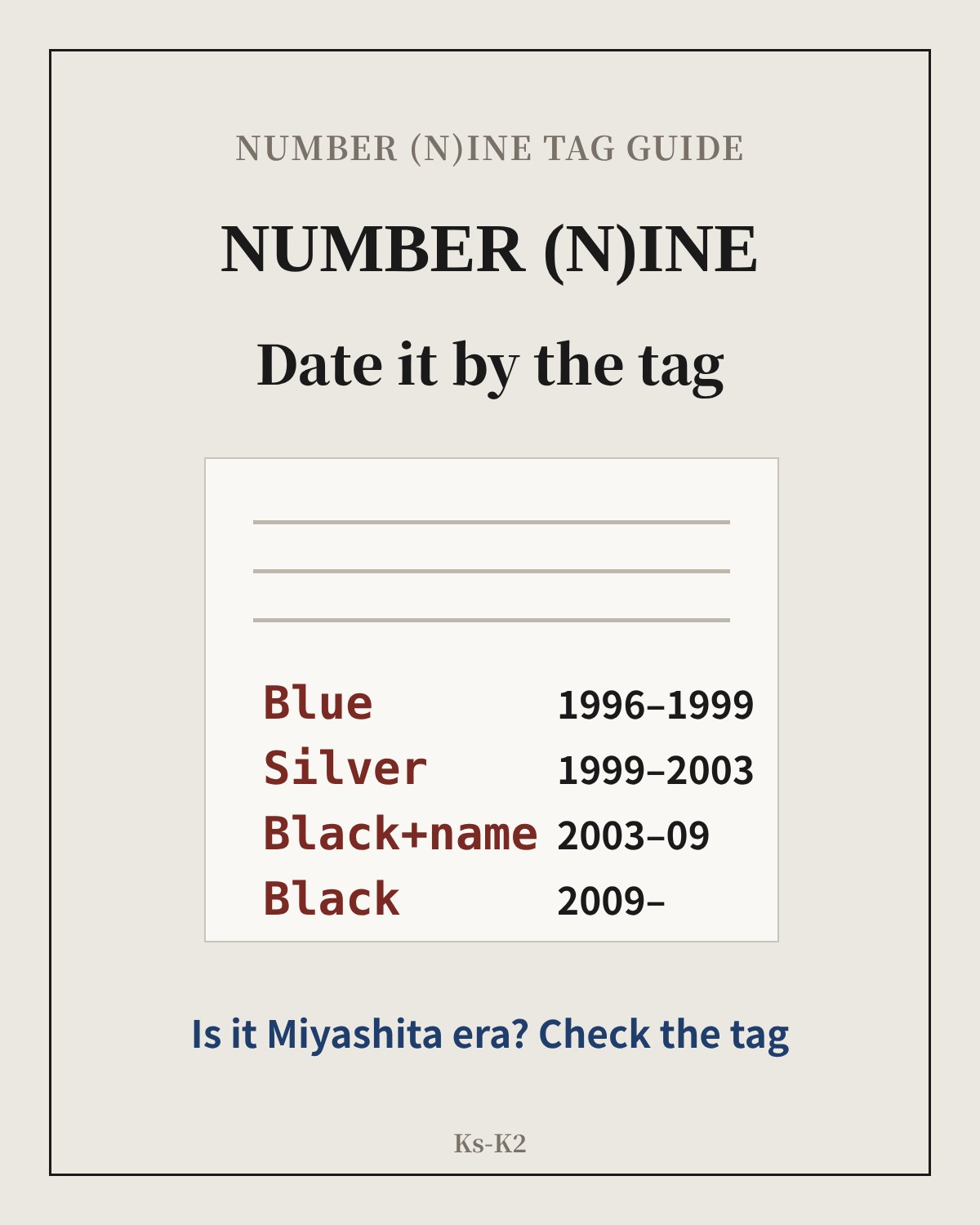
In this guide I sort NUMBER (N)INE tags into 4 types, with the estimated era for each and how to tell whether a piece is from the Miyashita era.
In short: there are 4 tags. The black tag with his name = Miyashita era from Kurt onward
| Tag | Era (approx.) | Miyashita era? | In a word |
|---|---|---|---|
| Blue tag | c. 1996–1999 | Yes | The very first period |
| Silver tag | c. 1999–2003 | Yes | The rock influence grows. The “target tag” is also from this time |
| Black tag (with name) | c. 2003–2009 | Yes | From the Kurt Cobain season. Takahiro Miyashita’s name on it |
| Black tag (brand only) | 2009 onward | No | After Miyashita left |
*The era boundaries are estimates based on material from Qkaku, a Japanese archive specialist. There are exceptions by item.
The 4 tags, one by one
*The illustrations only show the shape and color. The actual lettering is not reproduced.
Blue tag (c. 1996–1999)
The oldest tag, from the early days of the brand. The theme back then is said to have been “quality casual wear,” and the later rock image wasn’t strong yet. Very few exist, so you rarely see them second-hand.
Silver tag (c. 1999–2003)
A white to silvery tag. This overlaps with the time the brand started showing at Tokyo Collection, when the rock influence suddenly got much stronger. Popular seasons like TIME and STANDARD fall in this tag’s era.
From the same period there is also the so-called “target tag.” A Japanese reuse shop describes it as being used on items from the 2000 Spring/Summer and Autumn/Winter seasons.
Black tag with name (c. 2003–2009)
A black tag with white, handwritten-style lettering. Along with “New York” and “Tokyo,” it carries Takahiro Miyashita’s name — that’s the key feature. It is said to have started with the legendary Kurt Cobain season.

This tag overlaps with Number (N)ine’s golden era, so it’s the one archive collectors look for the most.
Black tag, brand name only (2009 onward)
Also black, but only the brand name in block letters, without Miyashita’s name. This is the tag used after he left the brand in 2009.
Many of these designs are based on past classics, so from photos alone they’re easy to mistake for Miyashita-era pieces. Even if a listing says “Miyashita era,” always check the tag photo.
Is it Miyashita era? 3 steps
- Does the tag say “Takahiro Miyashita”? If yes, it’s Miyashita era, c. 2003–2009.
- No name, but a blue or silver tag? That’s the earlier Miyashita era, c. 1996–2003.
- Black with only the brand name in block letters? That’s 2009 onward, after he left.
People often assume “black tag = Miyashita era,” but there are two kinds of black tag. The point is to check whether his name is on it.
If you want to know the exact season
A tag only tells you the rough era. To pin down a season like Kurt or STANDARD, look at notations such as “03AW” in the listing and at the design of the item itself.
A tag alone can’t prove authenticity
- Don’t judge by the tag alone: look at the sewing, the fabric and the print quality as a whole.
- Check the care label (the Japanese 品質表示 tag) too.
- Avoid items that are far below market price. If you’re unsure, use an authentication service or a shop that knows archive pieces.
What about after the 2025 comeback?
In September 2025, Miyashita relaunched the brand as “NUMBER (N)INE BY TAKAHIRO MIYASHITA.” New items are released under that name. I’ll add details about the new tags here once they’re clear.
FAQ
Q. Is every black tag Miyashita era?
No. The black tag with his name is Miyashita era (c. 2003–2009), but the black tag with only the brand name is from 2009 onward.
Q. What era is the silver tag?
Roughly 1999–2003.
Q. What is the oldest tag?
The blue tag, said to be from about 1996–1999.
Q. What do sizes “1”, “2”, “3” mean?
Number (N)ine uses numbers for sizes. Generally 1 is close to S, 2 to M, 3 to L and 4 to XL, but fit varies a lot by era and item, so for vintage pieces it’s safest to check the actual measurements.
Summary
- The tag changed from blue → silver → black (with name) → black (brand only).
- The black tag with his name is the Miyashita era from Kurt onward (c. 2003–2009).
- There are two black tags. Check whether Miyashita’s name is on it.
- The tag is only a guide. Judge authenticity from the whole piece.
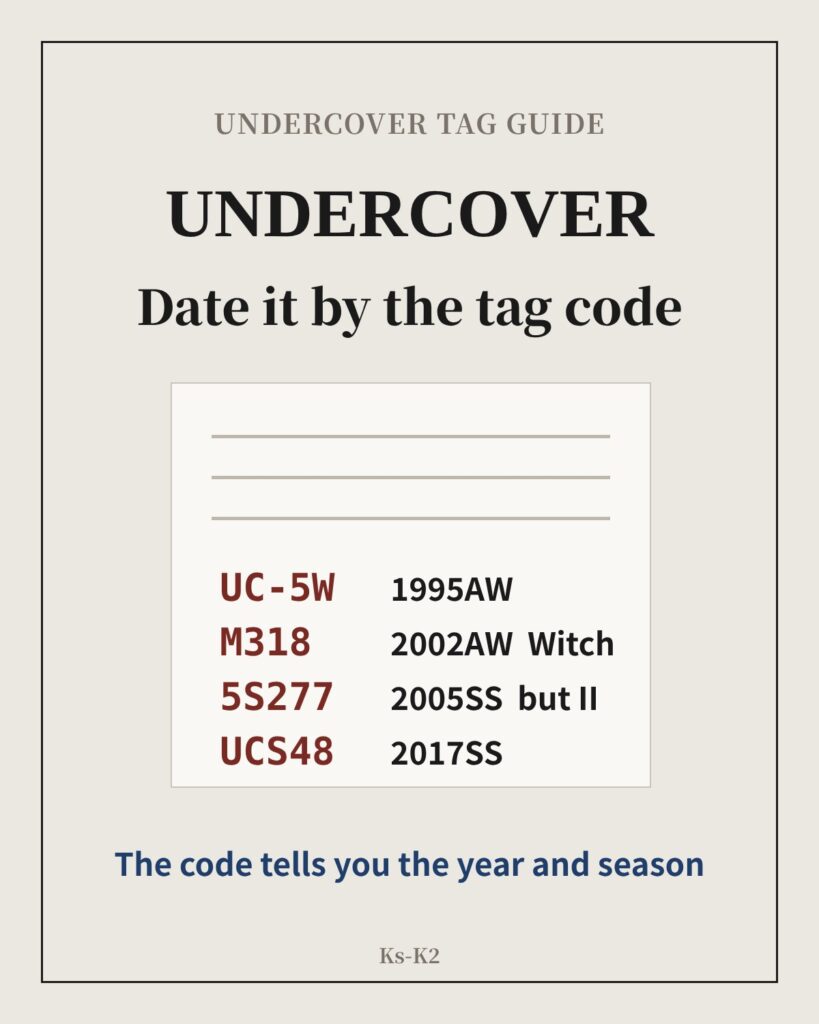
To date Undercover by the care label code, see this guide.
Sources: Qkaku “Number(N)ine” feature (Japanese) / Treasure Factory Style Funabashi (target tag, Japanese)

コメント