※本記事はアフィリエイト広告(プロモーション)を含みます。
When you shop for vintage Undercover, the same questions come up again and again: “What year is this?” “Is this really from the Witch era, or the but era?”
The most reliable answer is printed inside the garment, on the care label (the Japanese 品質表示 tag) as the product code. In Undercover codes, specific characters tell you the year and the season.
The rules changed several times over the years, so it can get confusing. In this guide I put everything together as simply as I can, using photos and codes from real tags. There is also a checker: type in the code and it tells you the estimated season.
3 quick steps
- Find the care label inside the garment
- Look for the letters and numbers next to 品番 (product code) or NO.
- Type that code into the checker below
You don’t need to memorize anything — the checker gives you an estimate. If you want to understand how it works, read the chart after it.
Where is the code? Check a real tag
This Instagram post by archive collector @noausterity shows 10 Undercover care labels side by side, from AW1995 to AW2020.
View this post on Instagram
The first slide is an AW1995 tag. The 品番 field reads UC-5W-P-02, and at the bottom you can see “(有)アンダーカバー” (Undercover Ltd.). Swipe right and the tags go 98AW → 02AW → 05SS → 04AW → 04SS → 10SS → 15AW → 17SS → 20AW, so you can see how the position of the code and the tag layout changed over time.
Besides the 品番 field, the code is often next to “NO.” or, on English tags, right under “UNDERCOVER Co.,Ltd” or “MADE IN JAPAN”.
Quick chart: the shape of the code tells you the era
Which character to read depends on the shape of the code. Compare your code with the examples and find the closest match.
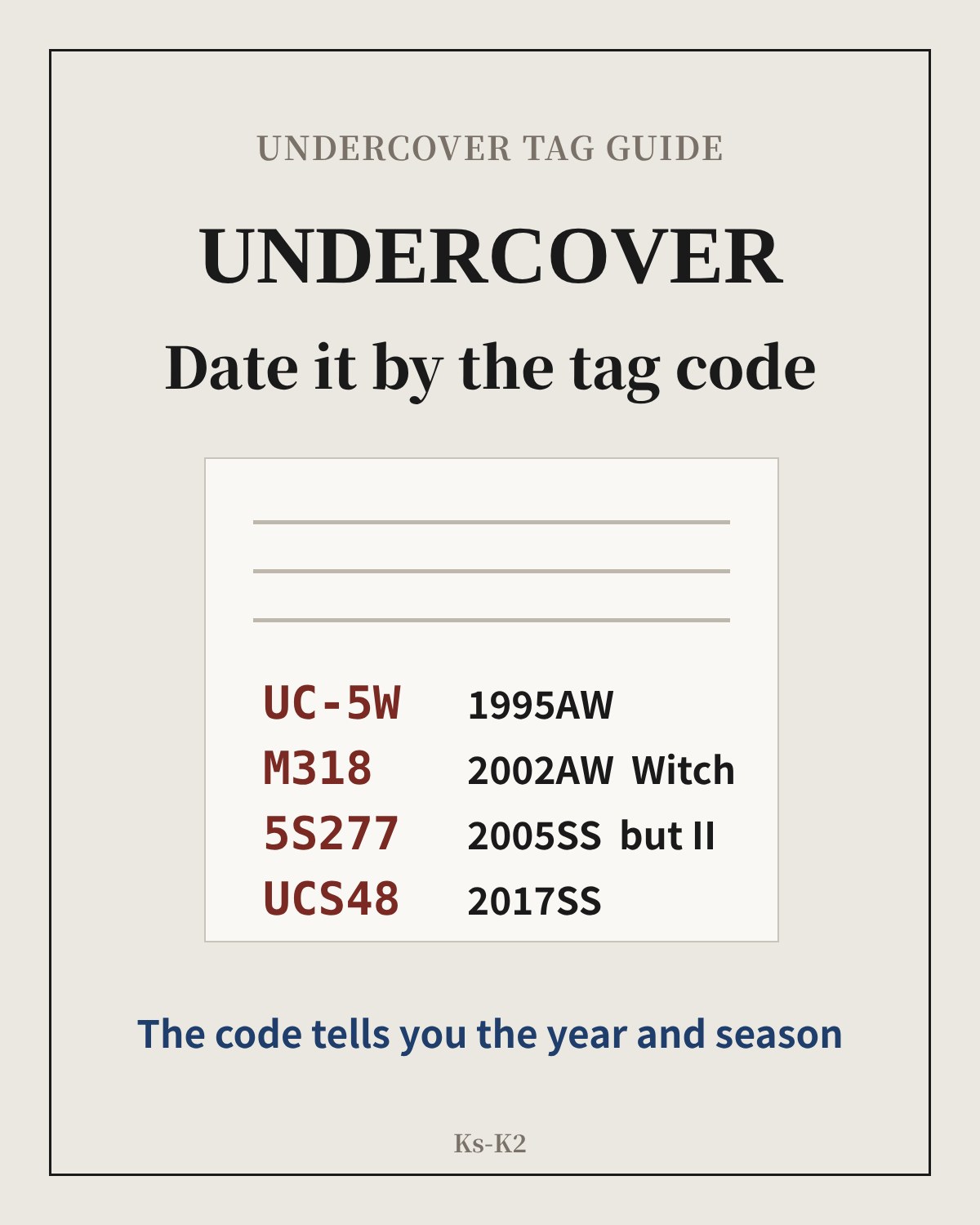
UC-5W-P-023rd = last digit of the year, 4th = season (S = SS / W = AW)→ AW199599No letters, only 2–3 digits→ AW1998M3181 letter + 2–3 digits. The letter = year and season→ AW2002 (Witch era)5S277-P191st = last digit of the year, 2nd = season (S = SS / A = AW)→ SS2005E42111 letter + 4 digits. The letter = year and season→ SS2010UCS4801First 2 = line, 3rd letter = year and season→ SS2017UC1D45063rd = season (1 = SS / 2 = AW), 4th = year (A = 2021)→ SS2024Below, each era in more detail.
Up to SS1998: “UC-5W-…”
Ignoring hyphens, the 3rd character is the last digit of the year and the 4th is the season (S = Spring/Summer, W = Autumn/Winter). “UC-5W-P-02” is AW1995, and “UC-7S-…” is SS1997. The “P-02” part is an item code and has nothing to do with the year.
AW1998: numbers only
For this one season, codes are just 2–3 digits, like “99”. If there are no letters at all, it’s safe to assume this season.
1999–2004: 1 letter + 2–3 digits
This is the era with the most sought-after archive seasons: the Witch era, SCAB, the but era and more. The first letter tells you the year and season (e.g. M318, E45-J8, B208-B4).
| 1st letter | Season | Season title |
|---|---|---|
| C | SS1999 | — |
| Q | AW1999 | — |
| K | SS2000 | TEASTER |
| D | AW2000 | MELTING POT |
| Z | SS2001 | INTER LOCKING PANELS |
| S | AW2001 | D.A.V.F. |
| J | SS2002 | THE ILLUSION HAZE |
| M | AW2002 | WITCH’S CELL DIVISION (Witch era) |
| U | SS2003 | SCAB |
| V | AW2003 | PAPER DOLL |
| E | SS2004 | LANGUID |
| B | AW2004 | but beautiful… (but era) |
2005–2007: number + S / A
The 1st character is the last digit of the year and the 2nd is the season (S = Spring/Summer, A = Autumn/Winter). Note that only in this era, Autumn/Winter is “A”, not “W”.
| Starts with | Season | Season title |
|---|---|---|
| 5S | SS2005 | but beautiful II (but era) |
| 5A | AW2005 | ARTS & CRAFTS |
| 6S | SS2006 | T |
| 6A | AW2006 | GURUGURU |
| 7S | SS2007 | PURPLE |
| 7A | AW2007 | — |
Real examples: 5S277-P19 (SS2005), 5A283-P20 (AW2005), 7S212-B1 (SS2007). The famous “85 denim” is also from this era.
2008–SS2015: 1 letter + 4 digits
The shape is the same “1 letter + numbers” as 1999–2004, but there are 4 digits (e.g. E4211, J4304-1).
| 1st letter | Season | 1st letter | Season |
|---|---|---|---|
| A | SS2008 | I | SS2012 |
| B | AW2008 | J | AW2012 |
| C | SS2009 | K | SS2013 |
| D | AW2009 | L | AW2013 |
| E | SS2010 | M | SS2014 |
| F | AW2010 | N | AW2014 |
| G | SS2011 | O (letter) | SS2015 |
| H | AW2011 |
*The “O” for SS2015 is the letter O, not the number 0. From AW2013, only the diffusion lines JohnUNDERCOVER and Sue UNDERCOVER start with a 2-letter line code, and the 3rd character is the letter from the table above.
AW2015–2020: the 3rd letter after “UC”
Codes start with a 2-letter line code (“UC” for the main line), and the 3rd letter tells you the year and season (e.g. UCP9205, UCS4801, UCZ4203-2).
| 3rd letter | Season | 3rd letter | Season |
|---|---|---|---|
| P | AW2015 | V | AW2018 |
| Q | SS2016 | W | SS2019 |
| R | AW2016 | X | AW2019 |
| S | SS2017 | Y | SS2020 |
| T | AW2017 | Z | AW2020 |
| U | SS2018 |
2021 onward: 3rd = number, 4th = letter
The 3rd character (a number) is the season (1 = Spring/Summer, 2 = Autumn/Winter), and the 4th (a letter) is the year. A is 2021, then B, C, D… one letter per year.
| 4th letter | Year | Example |
|---|---|---|
| A | 2021 | UC1A… = SS2021 |
| B | 2022 | UC2B… = AW2022 |
| C | 2023 | UC1C… = SS2023 |
| D | 2024 | UC1D4506 = SS2024 |
| E | 2025 | UC2E… = AW2025 |
| F | 2026 | UC1F… = SS2026 |
Same letter in two eras? Count the digits
Single first letters were used in two eras: 1999–2004 and 2008–2015. So for B, C, D, E, J, K and M, the letter alone doesn’t tell you which era it is.
In that case, look at how many digits follow the letter. Comparing real tags, the difference is clear.
| 1999–2004 | 2008–2015 | |
|---|---|---|
| Digits | 2–3 | 4 |
| Real examples | M318, E45-J8, B208-B4 | E4211, J4304-1, B4909 |
| 1st letter | With 2–3 digits | With 4 digits |
|---|---|---|
| B | AW2004 (but era) | AW2008 |
| C | SS1999 | SS2009 |
| D | AW2000 | AW2009 |
| E | SS2004 | SS2010 |
| J | SS2002 | AW2012 |
| K | SS2000 | SS2013 |
| M | AW2002 (Witch era) | SS2014 |
For example, “M318” is AW2002, the Witch era. The same “M” followed by 4 digits is SS2014. If you’re unsure, also check whether the design matches that season.
What the tag itself tells you
The brand label at the neck usually doesn’t show the year. But the care label has a few clues.
- “(有)アンダーカバー”: seen on care labels up to around 1998 (e.g. UC-5W-P-02).
- “(株)アンダーカバー” / “UNDERCOVER Co.,Ltd”: seen on tags from the 2000s onward. There are Japanese and English versions.
- Black care labels: according to overseas collectors, black tags started around SS2017.
- The reissue line “UNDAKOVRIT”: remakes of past items. You can’t date them from the tag, so tell them apart from the originals.
If the checker can’t identify your code
- Did you enter the size or RN number? “1, 2, 3” or “S, M, L” are sizes. Enter the code next to 品番 or NO.
- 0 (zero) vs O, 1 vs I: depending on the font they look alike. Try swapping them.
- Tag cut off or no photo: on Mercari or eBay, ask the seller for a photo of the care label before buying.
- UNDAKOVRIT and some collaborations: some items can’t be dated by code.
The code can help you spot fakes
The product code is also a clue for spotting fakes.
- Code and season don’t match: the listing says “but era,” but the code points to a different year.
- Wrong code shape: 4 digits on an AW2002 piece, for example — the shape doesn’t match the era.
- Different lettering: thin characters, a different font, or odd spacing.
- Far too cheap, or the same item listed in bulk.
FAQ
Q. Can I date it from the neck label alone?
Usually not. Use the product code on the care label inside.
Q. What is the Witch era code?
AW2002 (the Witch era) is “M” + 2–3 digits (e.g. M318). “M” + 4 digits is SS2014, so count the digits.
Q. What is the but era code?
AW2004 is “B” + 2–3 digits (e.g. B208-B4), and SS2005 (but beautiful II) starts with “5S”.
Q. What is the SCAB code?
SS2003 (SCAB) starts with the letter “U”.
Q. I can’t find the code
There are often several care labels stacked together, so flip through all of them. If the tags have been cut off, you can’t date it by code and will have to judge from the design and the brand label.
Summary
- Date Undercover by the product code on the care label.
- The shape of the code tells you which character to read.
- When the same letter appears in two eras, count the digits (2–3 or 4).
- When in doubt, try the checker.
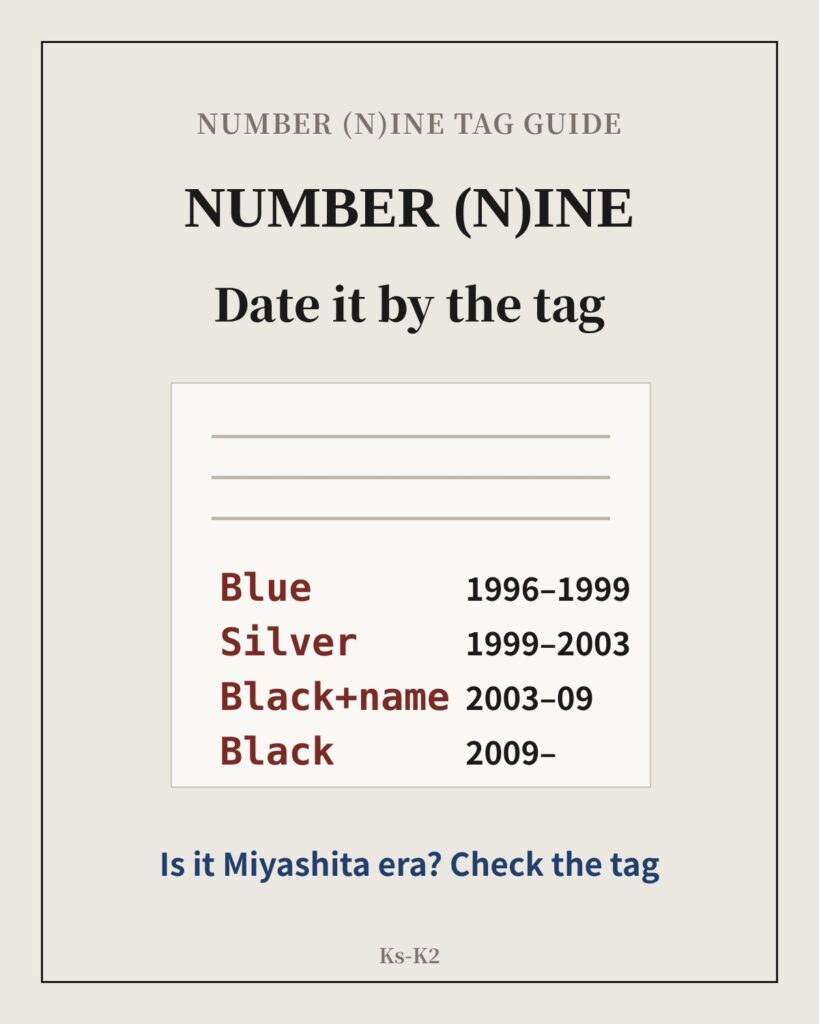
For Number (N)ine tags, see this guide.
Sources: GEEKS BLOG (Japanese) / @noausterity “Undercover guide” / UNDERCOVER collection list (mae-nishi, Japanese)

コメント