※本記事はアフィリエイト広告(プロモーション)を含みます。
Stone Island — the brand known for the compass badge on the chest or sleeve. You see it all the time in vintage shops and on Mercari, but it’s also a brand where you often wonder, “What year is this?” or “Is this really 90s archive?”
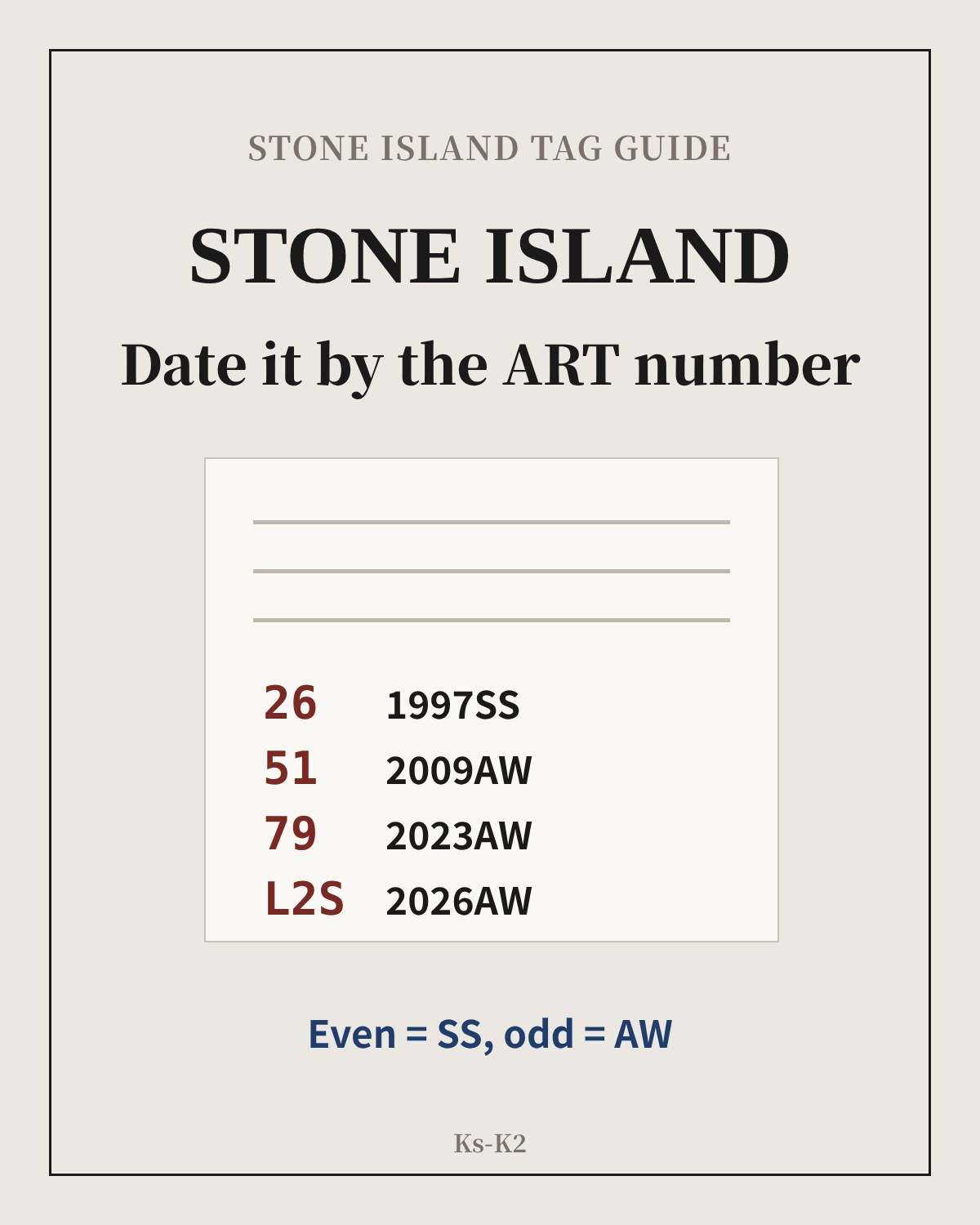
In fact, the first two digits of the “ART” number on the inner label tell you the year and season. In this guide I explain how to read it using numbers from real tags. There’s also a checker — type in the number and it tells you the era.
- 3 quick steps
- What kind of brand is Stone Island?
- How to read the “ART” number
- Why are the badges different colors? Every type, explained
- 1. The classic: green and yellow compass on black
- 2. White compass: Special Process
- 3. Ghost: the same color as the garment
- 4. Shadow Project: the black badge
- 5. Treated badges: matching the garment’s treatment
- 6. Mesh and denim badges
- 7. Anniversary badges: 30th and 40th
- 8. Collaborations and limited editions
- Faded badges and spotting fakes
- What the labels tell you
- Classics by era
- How to avoid fakes
- FAQ
- Summary
3 quick steps
- Find the label with the brand name inside the garment (at the neck or side seam)
- Look at the characters next to “ART”
- Type that number into the checker below
Roughly speaking: if the first two digits are even, it’s Spring/Summer; odd, Autumn/Winter. The bigger the number, the newer the year.
What kind of brand is Stone Island?
Stone Island was born in Italy in 1982. Its founder was Massimo Osti, who also created C.P. COMPANY. It started with jackets made from “Tela Stella,” a fabric developed by studying truck tarpaulins.
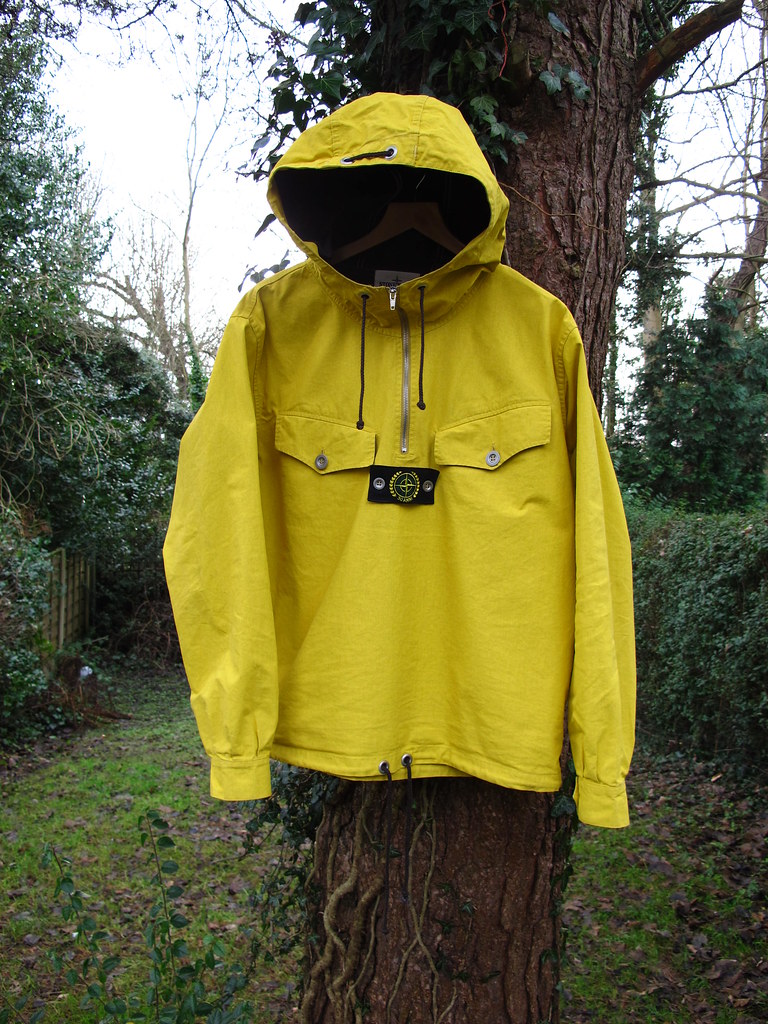
Its defining feature is research into fabrics and dyeing: fabrics that change color with temperature, fabrics that reflect light, garment dyeing (dyeing after the garment is sewn) — experimental clothes no other brand makes. It’s also deeply tied to street culture, from football terrace culture to UK hip-hop.
How to read the “ART” number
Stone Island labels carry an “ART” (article = product code) number. Up to 2024 it’s an alphanumeric code of about 9 characters: the first two digits are the year and season, the next two the line, and the 5th character the item type.
26154F07First 2 = year & season, next 2 = line, 5th = item→ SS1997 (Formula Steel coat)51154I9951 is odd, so AW. 15 = main line, 4 = jacket→ AW2009 (Ice Jacket)79156305179 is odd, so AW→ AW2023L2S156100015Letter = year (K = 2025, L = 2026), number = season (1 SS / 2 AW)→ AW2026 (new format)First two digits: year and season
The first two digits go up by one every season. Even = Spring/Summer, odd = Autumn/Winter. For example, “60” is SS2014 and “61” is AW2014. Counting starts from “12” for SS1990.
| Year | Spring/Summer | Autumn/Winter |
|---|---|---|
| 1994 | 20 | 21 |
| 1995 | 22 | 23 |
| 1996 | 24 | 25 |
| 1997 | 26 | 27 |
| 1998 | 28 | 29 |
| 1999 | 30 | 31 |
| 2000 | 32 | 33 |
| 2001 | 34 | 35 |
| 2002 | 36 | 37 |
| 2003 | 38 | 39 |
| 2004 | 40 | 41 |
| 2005 | 42 | 43 |
| 2006 | 44 | 45 |
| 2007 | 46 | 47 |
| 2008 | 48 | 49 |
| 2009 | 50 | 51 |
| 2010 | 52 | 53 |
| 2011 | 54 | 55 |
| 2012 | 56 | 57 |
| 2013 | 58 | 59 |
| 2014 | 60 | 61 |
| 2015 | 62 | 63 |
| 2016 | 64 | 65 |
| 2017 | 66 | 67 |
| 2018 | 68 | 69 |
| 2019 | 70 | 71 |
| 2020 | 72 | 73 |
| 2021 | 74 | 75 |
| 2022 | 76 | 77 |
| 2023 | 78 | 79 |
| 2024 | 80 | 81 |
*Items from before 1994 reportedly don’t always follow a consistent number format.
3rd–4th digits: line
| Number | Line |
|---|---|
| 15 | Main line (the most common) |
| 19 | Shadow Project (black-badge line) |
| 16 | Junior (kids) |
| 14 | Stone Island Denims |
| 25 | Special Edition (collabs etc.) |
5th character: item type (approx.)
The 5th character roughly indicates the item: “4” for jackets and outerwear, “3” for pants, “1” for shirts, “2” for T-shirts and polos, and so on. It doesn’t always match the actual item, so use it only as a hint.
Numbers starting with “10,” and the new format from 2025
- Numbers starting with “10”: used for core or restocked items made across seasons; they reportedly don’t indicate the year or season.
- From 2025: the format changed to something like “K1S” or “L2S.” The letter appears to be the year (K = 2025, L = 2026) and the number the season (1 = SS, 2 = AW).
Why are the badges different colors? Every type, explained
Collectors have identified nearly 30 types of Stone Island badge. The colors and materials differ mainly for four reasons:
- Different lines: main line, Shadow Project, Ghost, etc.
- Different treatments and fabrics: garments with special fabrics or treatments get matching badges.
- Different eras: the border color and construction changed over time.
- Anniversaries and collabs: 30th and 40th anniversary badges, and special designs for collaborations.
First, the big picture. Below, overseas collector @toms.archive lays out 40 years of badges, from 1982 to 2022, with their names.
View this post on Instagram
*Badge names such as Special Process and Ghost are terms used among collectors and are not necessarily official brand names.
Now let’s go type by type.
1. The classic: green and yellow compass on black
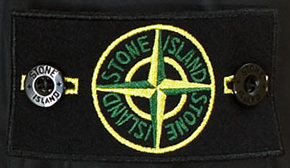
The most common badge, attached to the garment with two buttons. Even the classic badge varies slightly by era.
| Name | Features | Era (approx.) |
|---|---|---|
| Hand-stitched | The earliest, hand-embroidered badge | 1982–83 |
| Green edge (vintage green) | Green border | Up to about AW1999 |
| Classic | Black border | From about 2000 to today |
The green-edged badge alone makes a piece popular on the vintage market. Below is an AW1995 sweater posted by a vintage shop.
View this post on Instagram
2. White compass: Special Process
A black badge with a white embroidered compass. Collectors call it “Special Process,” and it is said to appear on pieces using special fabrics or treatments, such as the color-changing Ice Jacket or reflective fabrics. When people talk about the “white badge,” this is usually what they mean.
3. Ghost: the same color as the garment
A tonal series where even the badge matches the garment color. There are many colors — black, white, grey, beige, brown, khaki, navy, red and more. The all-white badge belongs to white Ghost pieces.
View this post on Instagram
4. Shadow Project: the black badge
The experimental, techwear-leaning line “Shadow Project” uses a black badge. Another giveaway: digits 3–4 of the ART number are “19.”
View this post on Instagram
5. Treated badges: matching the garment’s treatment
On specially treated pieces, the badge sometimes gets the same treatment.
| Name | Look |
|---|---|
| Frost | Whitish, faded, as if covered in frost |
| Hand corrosion | A hand-applied corrosion treatment with a washed-out look |
| Off-dye | Uneven dyeing makes the compass colors blotchy |
| Dust treatment | A dull, dusty-looking finish |
| Hand paint | Paint dripped by hand; every piece is different |
| Paintball camo | Splattered colors to match camo garments |
| Glow in the dark | A compass that glows in the dark |
6. Mesh and denim badges
There are also lightweight mesh badges and blue badges made of denim. Mesh badges come with the classic-colored compass or the white compass.
7. Anniversary badges: 30th and 40th
Badges with a laurel wreath around the compass are anniversary pieces. “30 ANNI” is from the 30th anniversary in 2012, and “40 ANNI” from the 40th in 2022.
8. Collaborations and limited editions
In collaborations such as with Supreme, the compass can come in special colors or designs, like red or white. Below is the AW2023 Supreme collaboration.
View this post on Instagram
Faded badges and spotting fakes
- Aging: old badges can fade from sun and washing, making the green and yellow look paler.
- Be careful with badges sold alone: badges are sold separately, and many are fake. Even if the badge on a garment is real, the garment itself may not be.
- Check that it all adds up: see whether the badge type matches the line and era from the ART number. For example, a green-edged badge on a 2005 piece doesn’t fit — look again carefully.
What the labels tell you
- Certilogo: the authentication tag attached since SS2014. If the number starts with “60” or higher, it should have one — and if a pre-2014 piece has one, be careful.
- ART number: tells you the year, season and line. Try it in the checker above.
Classics by era
The Osti era (1982 to early 1990s)
The era when founder Massimo Osti created the fabrics that became the brand’s foundation: Tela Stella, Raso Gommato (rubber-coated glossy fabric), the thermosensitive fabric, Reflective and more. Pieces from this era are rare and popular with collectors.
The Paul Harvey era (1996–2008)
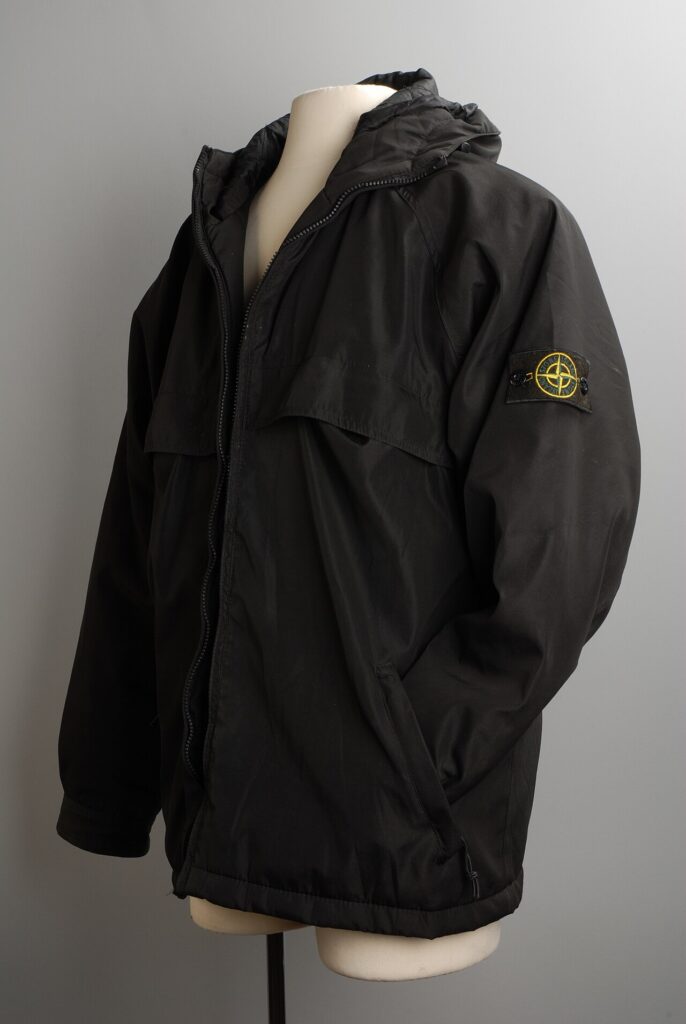
The era of British designer Paul Harvey. Carrying on Osti’s fabric research, it produced lots of rugged, cool outerwear based on military and workwear. The “Formula Steel” coat (SS1997), woven with stainless steel, is well known. It’s one of the most sought-after eras on the vintage market.
In November 2026, the official account shared a talk at Central Saint Martins in London between Paul Harvey, designer Aitor Throup (who also worked with Stone Island) and Carlo Rivetti.
View this post on Instagram
Search Paul Harvey-era pieces on Mercari Japan →
Ice Jacket (the color-changing jacket)
A jacket in a fabric that changes color as the temperature drops — one of Stone Island’s signature classics. Based on a fabric born in the late 1980s, it has been remade many times. The post below is an AW2009 Ice Jacket: the “51” at the start of “Art no. 51154I99” in the description means AW2009.
View this post on Instagram
Search Ice Jackets on Mercari Japan →
Stone Island today
Fabric research has continued since the brand joined Moncler in 2021. Many campaign photos on the official account are shot in snow and ice, showing the garments’ function and world at a glance.
View this post on Instagram
View this post on Instagram
How to avoid fakes
- Does the number match the season? If a listing says “90s” but the number starts with “60” or higher, it’s 2014 or later.
- Does Certilogo add up? Missing on a post-SS2014 piece, or present on a pre-2014 piece — both are red flags (some shops do cut the tag off).
- Badge embroidery: uneven letter height or thickness, or letters crowding the border, are common signs of fakes.
- No tag photos: ask for photos of the inner label and badge before buying.
FAQ
Q. Where is the “ART” number?
On the inner label with the brand name and “MADE IN ITALY” etc. It’s the code next to “ART” or “ART.” — often sewn together with the care label.
Q. How do I know if it’s from the 90s?
If the number starts with 20–31, it’s from the 1990s (1994–1999). 12–19 means 1990–1993, though the number format then was not always consistent.
Q. What is “green edge”?
A badge with a green border, considered a sign of older pieces. It reportedly changed to a black border around 2000.
Q. The Certilogo tag has been cut off
Some shops sell items with the Certilogo tag removed. In that case, judge by whether the ART number, badge and label layout all match. If you’re unsure, an authentication service is an option.
Summary
- The first two digits of the inner label’s “ART” number tell you Stone Island’s era.
- Even = Spring/Summer, odd = Autumn/Winter. 60 = SS2014, 61 = AW2014.
- The next two digits are the line (15 = main line, 19 = Shadow Project).
- From 2025, a new format like “K1S” or “L2S.”
- The badge border and Certilogo are also clues to the era.
For Dior Homme, see how to spot Hedi-era Dior Homme; for Undercover, how to read Undercover codes.
Sources: Wikipedia “Stone Island” / LuxeDetect “Stone Island ART Number Decoder” / Legitique “Stone Island ART Number Checker” / Evo Island “Art Number Explained.” Number examples were checked on tags in Mercari and Instagram listings.

コメント